Though much science communication explains facts and processes, the most memorable communication moves readers toward deeper insights about the nature of the universe and themselves. To achieve this change, science communicators may need to move beyond explanatory thesis statements toward transformative interpretive themes. While both overlap, their difference hinges on the theme’s explicit goal to shift perspective, so that relationships to science and nature expand. Consider these examples:
- The collapse of human civilizations is not a history of slowing degrading ability to provide basic services, but a long ignorance of society’s decline by its leaders. — Based on Jared Diamond’s Collapse
- Scientific paradigms do not arise incrementally by scientists standing on their forebears’ shoulders, but rather are destroyed by the very young or those new to the field whose paradigm they overthrow. Thomas Kuhn’s The Structure of Scientific Revolutions
- The human brain carries within it the evolutionary memory of life on Earth. Carl Sagan’s Dragons of Eden
- Beneath apparent randomness, the universe organizes itself through recurring patterns across all scales. James Gleick’s Chaos
These books impacted me profoundly. They all revealed insight into reality. These sentences which I wrote based on their main ideas are not merely summaries — they are interpretive themes that provoke my deep thinking. Their challenge is not to educate, but forge new connections and transform mental models.
The interpretive theme originates from the heritage interpretation field, that branch of communication that commonly works in heritage and science venues such as parks, museums, and archeological sites, but also through articles, videos, and other media. Yet this emphasis on crafting a powerful theme or Big Idea that not only organizes communication structure, but transforms audiences, pushes communication planning along the spectrum from information toward inspiration.
Dr. Sam Ham, University of Idaho emeritus professor, researched for thirty years the psychological and communicational sciences to lay down a theoretical foundation for the interpretive theme and how it influences the human mind. It works like this: whether reading themes directly or engaging them through media provokes (key word in this field) audiences to process ideas. The longer audiences actively think about an idea and connect it to their own lives, the more likely it reshapes how they understand the world.
An interpretive theme has two power dimensions. It must first embody a compelling Big Idea, and then its sentence must effectively deliver that theme, what I call the vehicle. The former usually requires far more effort and time to create than the latter. My book, the Interpretive Theme Writer’s Field Guide, includes the Interpretive Theme Writer’s Worksheet whose chapters or stops I share to craft the Big Idea and then the well-written sentence to deliver it to the audience.
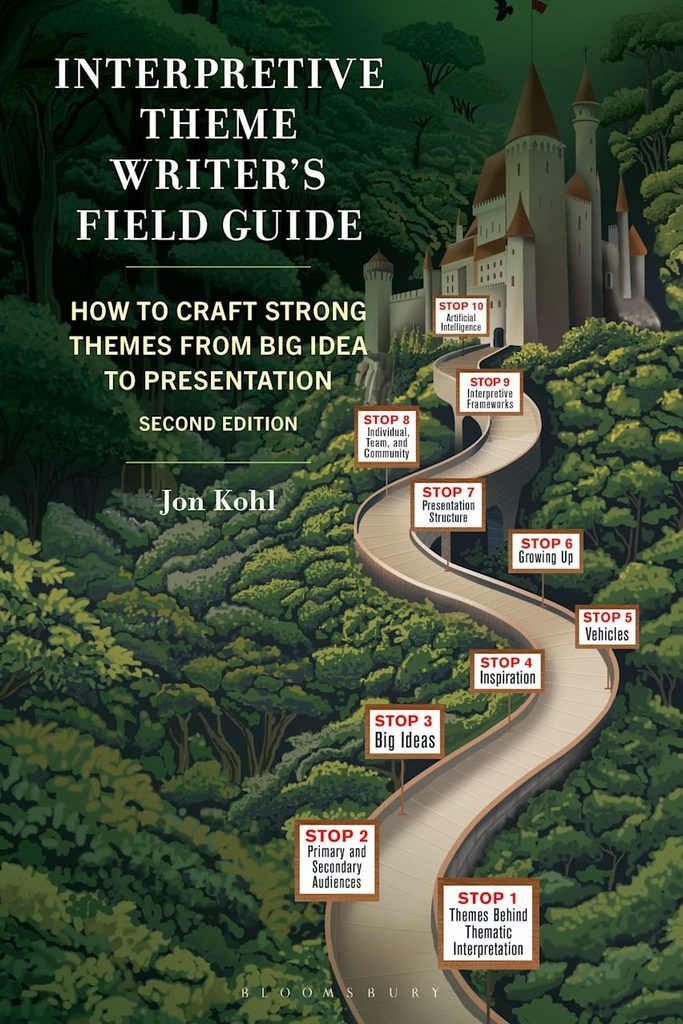
Stop 1 — Communication Purpose
Sometimes writers confuse purpose. Some sentences guide media to orient, inform, market, and publicize to audiences. Interpretive themes, on the other hand, transform thought. When a writer confuses educational goals, marketing slogans, or site regulations with interpretive themes, that confusion may radiate outward to audiences about what the communication attempts to achieve.
Stop 2 — Primary and Secondary Audiences
We should not write themes immediately for our audience as that risks attending to word choice, readability, and adaptation before the fundamental Big Idea. The primary audience constitutes the theme owners/writers. The theme must first appeal to them before adaptation to a secondary audience.
Stop 3 — Big Idea as a Complete Sentence
We often use “theme” to mean topic or noun, such as migratory birds. A theme, though, expresses a perspective, opinion, or idea about migratory birds in a complete sentence: “Despite their small size, Neotropical migratory birds link diverse forest, coastal, and marine habitats across continents, demonstrating how survival depends not just on one stop, but on the health of multiple distant landscapes.”
Stop 4 — Big Idea Qualities
Provocative Big Ideas have universal value. A universal theme illuminates reality more broadly than a specific topic or place. The risk is that without universal focus, a theme may simply describe rather than share a perspective that provokes thought, which the corresponding medium (e.g., museum exhibit) then develops for the audience to interpret on its own terms. A universal theme, then, expands audience relevance beyond the interpreted object, and the best themes take on big questions that simmer in the heart. Consider the following example from the book:
Local: As a signer of the Declaration of Independence, William Floyd provides a personal perspective on the risks to life, property, and reputation associated with being a patriot in New York during the War for Independence.
Universal: As governments or ways of governing change, often it is necessary to destroy the previous form and sometimes those, such as William Floyd, who promote the change as well.
You see how we use Floyd to illustrate the universal theme, but the local theme does not emanate universal value without major inference.
The goal of expanding audience perspective does not require memorizing ideas; it requires that audiences rewire neurons. This results in variations of the original theme in their minds which is fine.
Stop 5 — Vehicle
Once you craft a Big Idea, then you engineer it into a sentence that best communicates it. A variety of criteria help, some already well understood such as readability, clarity, third person, concrete imagery, strong nouns and verbs, and active voice. A strong theme may also include examples or just enough context so that readers understand its implications. “Prohibited” words to avoid, furthermore, include important, special, treasure, significant, gem, and other adjectives and metaphors that hide meaning rather than specify it: that is, the word “important” takes the place of actually saying what is important.
Adaptation to a Secondary Audience
Once you have a strong theme that appeals to the primary audience — you, your editorial team, or community — then adapt it to secondary audiences with local language, references, and concepts that increase relevance. Again, from the Field Guide:
Primary: Two hundred million years of dinosaurian dominance did not influence naming of geological time periods, while human building and cropping for mere thousands may result in the naming of the Anthropocene Epoch.
Secondary (birders): Bird ancestors flew and jumped with other dinosaurs for millions of years during which the geological time period did not change; now after mere millennia of human building and cropping, and the extinction of numerous charismatic bird species, the name may change to the Anthropocene Epoch.
Interpretive themes focus the science communicator’s attention on deeper meaning capable of provoking audiences to think more about how that idea may transform their way of seeing the world; in so doing, audience awareness of the interpreted science object and their experience during the interaction both deepen way beyond what scientific explanation alone can accomplish.
Download and view the Interpretive Theme Writer’s Worksheet:



Leave a Reply