Examples and tools for crafting hooks, context, and tension in science communication.
A strong opening determines whether a reader commits to your story or drifts away. In Part 1, we looked at the narrative tools that shape effective science communication—especially the And–But–Therefore (ABT) structure. Now we focus on the first 2–3 paragraphs, where those tools matter most. The goal of a good opening is simple: spark curiosity, deliver clarity, and introduce tension that propels the reader forward.
Below is a practical guide, with examples from published science writing and a sample from my own work, showing not just what to do but how to do it.
Start with a Hook
A hook isn’t hype. It’s a moment, detail, or statement that makes the reader think: Tell me more.
Look at this opening from Willem Marx (Scientific American, April 2025):
“In hindsight, I am still not sure why the operators of the Danish-flagged MV Coco allowed me onboard.”
It’s understated but charged with tension. Why was this surprising? What was at stake? With one sentence, the reader senses risk, uncertainty, and a story worth following.
Hooks can also work on a much larger scale. Think of the opening chapter of Astrophysics for People in a Hurry—a book that begins by zooming out to the origins of the universe. Tyson doesn’t start with definitions or equations; he starts with wonder. That’s the essence of a hook: an entry point that activates curiosity.
“In the beginning, nearly fourteen billion years ago, all the space and all the matter and all the energy of the known universe was contained in a volume less than one-trillionth the size of the period that ends this sentence.”
Your hook doesn’t need to be dramatic. It can be small, simple, and precise. The key is to choose an image, idea, or moment that opens a door and invites the reader in.
Establish the Essential Details
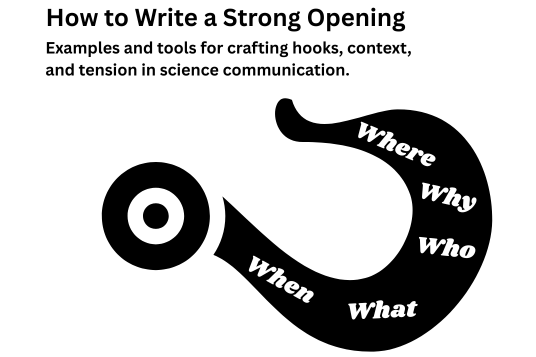
Once the hook grabs attention, the second paragraph should ground the reader. This is where you answer the essentials: who, what, when, where, and why. Think of this as the “And” in the ABT structure—the shared reality, the stable ground your story stands on.
This paragraph doesn’t need to be long. It just needs to orient the audience so they understand the situation and why it matters.
Here is an example from my blog (“How Do We Know the Universe Is Expanding?”):
“In the late 1920s, with a 100-inch telescope at Mount Wilson Observatory, Hubble found that galaxies were not standing still at all. They were racing away from us…”
In two sentences, I establish:
- who: Edwin Hubble
- where: Mount Wilson Observatory
- when: late 1920s
- what: galaxies moving away
- why: evidence of an expanding universe
It’s clear, grounded, and efficient—exactly what a second paragraph should be.
Introduce Tension and Stakes
The third paragraph is where your story acquires direction. This is the “But” in ABT: the challenge, contradiction, or puzzle that creates narrative tension.
Tension can come from:
- a surprising result
- a contradiction in the data
- a quote that raises the stakes
- a number that shows urgency or scale
- the human or emotional side of a scientific problem
In my blog example, the tension is Einstein’s mistake and the clash between theory and evidence:
“Einstein was skeptical at first, but the data spoke louder than theory… The sight forced him to abandon his static universe…”
The tension is intellectual, not dramatic—but it still creates momentum. The reader now understands what’s at stake: the rewriting of our understanding of the cosmos.
A good third paragraph answers: What is the friction at the heart of this story?
Without tension, even the clearest writing feels flat.
Set Up the “Therefore”
After establishing tension, your opening should gently point toward where the story is going. This doesn’t mean giving everything away—it simply means signaling the direction.
The “Therefore” is a promise. It tells the reader: Here’s what this story will explore next.
For example:
“Therefore, the team has shifted its entire research plan, launching a new set of experiments that could rewrite the field’s assumptions.”
The “therefore” sets up your transition into the body of the article, where the deeper reporting, explanations, and narrative beats unfold.
Conclusion
A strong opening is built with intention. Begin with a hook that sparks curiosity—no gimmicks needed. Ground the audience with the essential facts. Introduce tension through contradiction, data, or a compelling quote. And signal a clear “therefore” that sets the direction for the rest of the story.
You don’t need long, elaborate setups. The best science writing opens quickly, cleanly, and confidently. If you master these first few paragraphs, everything that follows becomes easier: readers would want to go where you’re taking them.



Thanks, waiting for part 3