Science communication is not only about explaining facts. It is also about creating conditions for people for all ages to understand, remember, and feel connected to what they are learning. This is why planetariums are such powerful tools for science communication. They do something that text alone often cannot do: they turn scientific ideas into experiences.
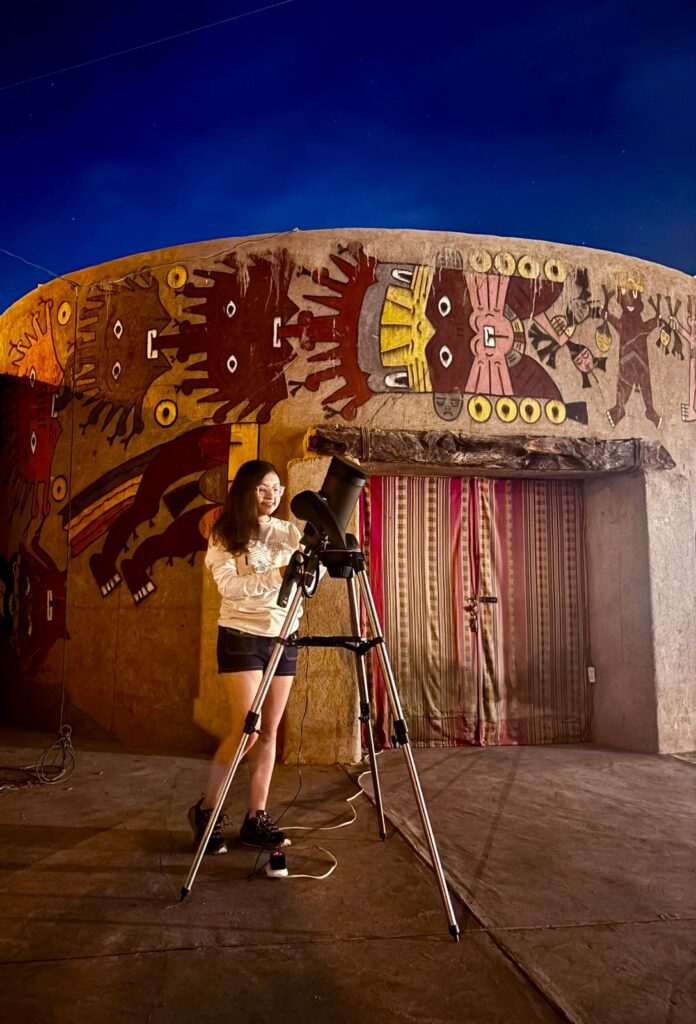
Astronomy is full of concepts that are difficult to imagine from words on a page. Scale, distance, movement, time, darkness, rotation, and the relationship between Earth and the sky are not always easy to understand through written explanations. A planetarium changes that. Inside a dome, audiences look up, follow movement, listen, and become part of a guided visual journey.
This immersive environment helps reduce the distance between scientific knowledge and public understanding. For someone without a scientific background, astronomy can feel abstract or intimidating. A planetarium makes it more accessible allowing people to experience the sky in a clear, visual, and emotional way. The audience does not need to begin with technical knowledge. They can begin with curiosity.
Immersion also supports memory. People may forget a paragraph they read, but they are more likely to remember the moment when the sky moved above them, when constellations appeared around them, or when a narrator connected the stars to human history. In fact, planetariums are not only educational spaces, they are storytelling spaces.
This is especially relevant when science communication connects with culture and place. In Peru, for example, the Planetarium María Reiche in Nazca, named after German mathematician María Reiche, helps visitors understand astronomy as something connected to history, culture, and place. By exploring the Nazca Lines, a set of enormous figures and geometric shapes drawn into the desert floor over 1,500 years ago that Reiche believed may have been linked to astronomy, visitors are offered an opportunity to understand the sky, the Nazca Lines, and the legacy of María Reiche through an experience that goes beyond information.
Text still matters. It gives context and accuracy. However, when the goal is to communicate complex scientific ideas to different kinds of audiences and reach more people, text can be strengthened by visual and sensory experiences. A planetarium does not replace explanation. It makes the explanation easier to understand.
For science communicators, planetariums offer an important lesson: sometimes the best way to make science understandable is not to simplify it too much, but to design an experience where people can enjoy and learn at the same time. Immersion works because it helps people stop just reading about science and start experiencing it. It makes science more accessible and memorable.
This idea opens a door worth walking through. If experience helps people remember what they learn, then science communicators should not see immersive formats as extra. They should be something to aim for. Not everyone has access to a planetarium, but the idea behind it can guide any kind of communication: turn information into something people can feel, not just read. The more we treat science communication as an experience, the more people we will reach, and the longer they will remember it. In the end, science is not only something we explain to people from a distance. It is also something we can invite people to live, to feel, and to carry with them long after the words are gone.



Leave a Reply