The next evolution of science or technical communication isn’t helping people know more. It’s helping them make better decisions because they know more.
That isn’t just a shift in wording. It’s a shift in purpose. It’s the difference between explaining science and technology and communicating strategically.
Every science communicator has had the same experience. You spend weeks crafting a technically flawless story. The science is accurate. The graphics are polished. Every subject matter expert signs off. And yet…nothing happens. The audience understands the discovery but never acts on its significance.
The report is read but not remembered.
The presentation is appreciated but not acted upon.
The article informs—but it never changes a decision.
That gap between understanding and action has always fascinated me.
Knowledge is not the endpoint of science communication. Better decisions are.
A recently published peer-reviewed study by Yubo Zhou and Dolores Albarracín may help explain why.
Across two preregistered experiments involving more than 1,500 participants, the researchers compared three kinds of messages: those expressing only an evaluation (“This technology is effective.”), those describing only a behavior (“I used this technology.”), and those combining both (“This technology is effective, and I used it.”). The combined messages consistently proved more persuasive than either attitudes or behaviors alone.
The study is about persuasion, not science communication. But its implications extend well beyond either consumer behavior or public health.
It provides empirical evidence for something many experienced communicators have long suspected but rarely articulated: information becomes more influential when people can connect it to action.
For science communicators the implication is even bigger.
If our audiences understand the science but never change a decision because of it, have we really communicated its significance?
Strategic science communication begins with the audience—not the science. It starts by understanding what people care about, the decisions they’re facing, and the questions they’re trying to answer. In a world saturated with information, relevance is created by designing communications around audience needs, not simply our expertise.
Much of science communication, however, still revolves around answering one question: What did we discover?
That’s an essential question. But it’s rarely the last question our audiences ask.
Program managers wonder whether to fund the next phase of research.
Researchers decide whether to build on a finding.
Physicians evaluate whether new evidence should influence clinical practice.
University leaders determine where to invest.
Policymakers compare competing approaches.
Industry partners decide whether a technology is mature enough to adopt.
None of them are simply trying to understand science. They’re trying to decide what to do because of it.
Our job isn’t simply to communicate evidence. It’s to help people recognize what that evidence enables.
Some readers may wonder whether emphasizing persuasion risks moving science communication too close to advocacy.
I don’t believe it does.
Persuasion, in this context, is not persuading people to accept conclusions unsupported by evidence. It is helping them recognize the implications of evidence that already exists. Explaining what a discovery makes possible is not advocacy. It is part of explaining why the discovery matters.
A New Lens for Evaluation Science Communication
Zhou and Albarracín’s research doesn’t propose a framework for science communication, nor should it. Their work advances our understanding of persuasion. Science communication has broader responsibilities that include building understanding, fostering trust, supporting informed decisions, and helping audiences recognize the significance of scientific discovery.
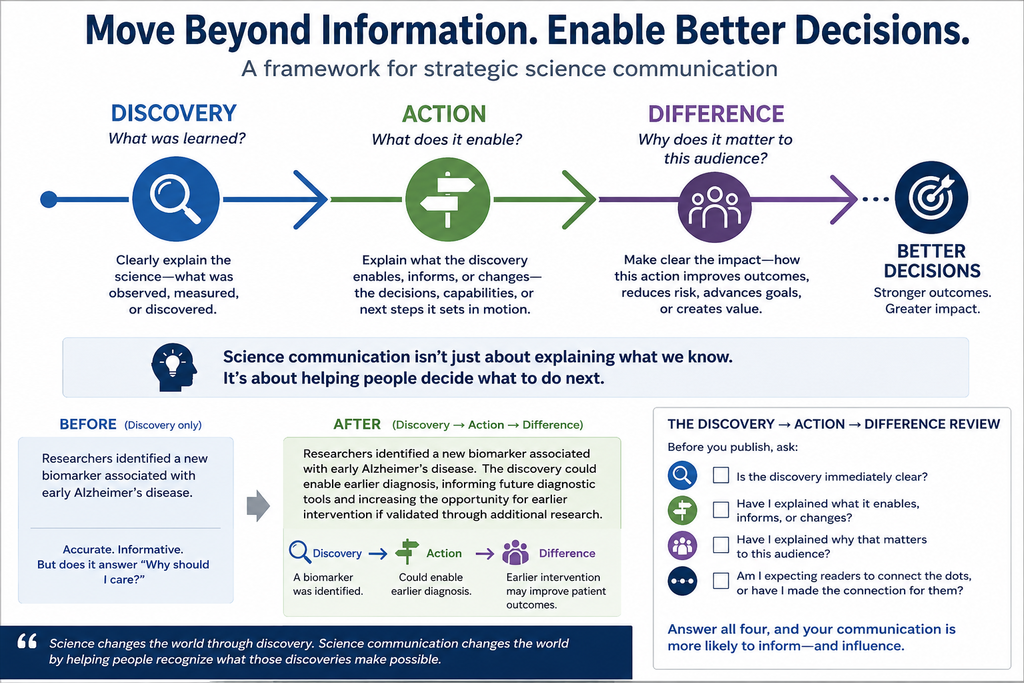
Inspired by their findings, every communication should answer three questions.
Applying the Discovery → Action → Difference Framework
The value of a framework isn’t that it gives us more work to do. It’s that it changes the questions we ask.
For years, many of us have evaluated science communications by asking questions like:
- Is it accurate?
- Is it clear?
- Is it technically complete?
Those questions remain essential. But this research suggests they are not sufficient.
Strategic science communicators should add three more:
Discovery
Did we clearly explain what was learned?
Action
Did we explain what the discovery enables, informs, or changes?
Difference
Did we make clear why that action matters to this audience?
Those three questions don’t replace the traditional review process—they strengthen it. They encourage us to evaluate communications not only for scientific accuracy, but also for strategic relevance.
A communication can be technically flawless and still fail if the audience never understands what the science makes possible.
Application Example
Imagine a biomedical press release.
Before
Researchers identified a new biomarker associated with early Alzheimer’s disease.
That’s where most releases stop.
After
Researchers identified a new biomarker associated with early Alzheimer’s disease. The finding could enable clinicians to detect the disease earlier, when interventions are more likely to preserve cognitive function and improve patients’ quality of life.
Discovery
A biomarker was identified.
↓
Action
The discovery could enable earlier diagnosis, informing future diagnostic tools and increasing the opportunity for earlier intervention if validated through additional research.
↓
Difference
Earlier intervention may improve patient outcomes.
Notice what didn’t change.
The science.
The evidence.
The accuracy.
What changed was the story’s ability to answer the question every audience is ultimately asking:
“Why should I care?”
If your communication answers only the first question, there’s a good chance you’re informing your audience without fully helping them understand why the science matters.
Persuasion is an important building block—not the destination
Some science communicators understandably hesitate when they hear the word persuasion.
We should.
Our responsibility is not to manipulate audiences or advocate beyond the evidence.
But persuasion, properly understood, is simply helping people connect information to meaning.
Meaning to understanding.
Understanding to better decisions.
This study doesn’t replace the principles that define our profession.
Accuracy still matters.
Transparency still matters.
Trust still matters.
Context still matters.
Instead, it strengthens those principles by providing evidence that the way we connect ideas influences whether audiences recognize their significance.
The next time you review a story, don’t ask only,
“Did we explain the science?”
Ask,
“Did we explain what the science makes possible?”
If the answer is no, the communication probably isn’t finished.
Science changes the world through discovery.
Science communication changes the world by helping people recognize what those discoveries make possible.
The future of our profession won’t be defined by how well we explain science.
It will be defined by how effectively we help people use science to make better decisions.
Evaluate science communication by the decisions it enables—not just the information it conveys.
The Discovery → Action → Difference Review
Before you publish…
Run every communication through the Discovery → Action → Difference review.
- □ Is the discovery immediately clear?
- □ Have I explained what it enables?
- □ Have I explained why that matters to this audience?
- □ Am I expecting readers to connect the dots, or have I done that work for them?
The answers may reveal the difference between a communication that informs and one that truly influences.


Leave a Reply