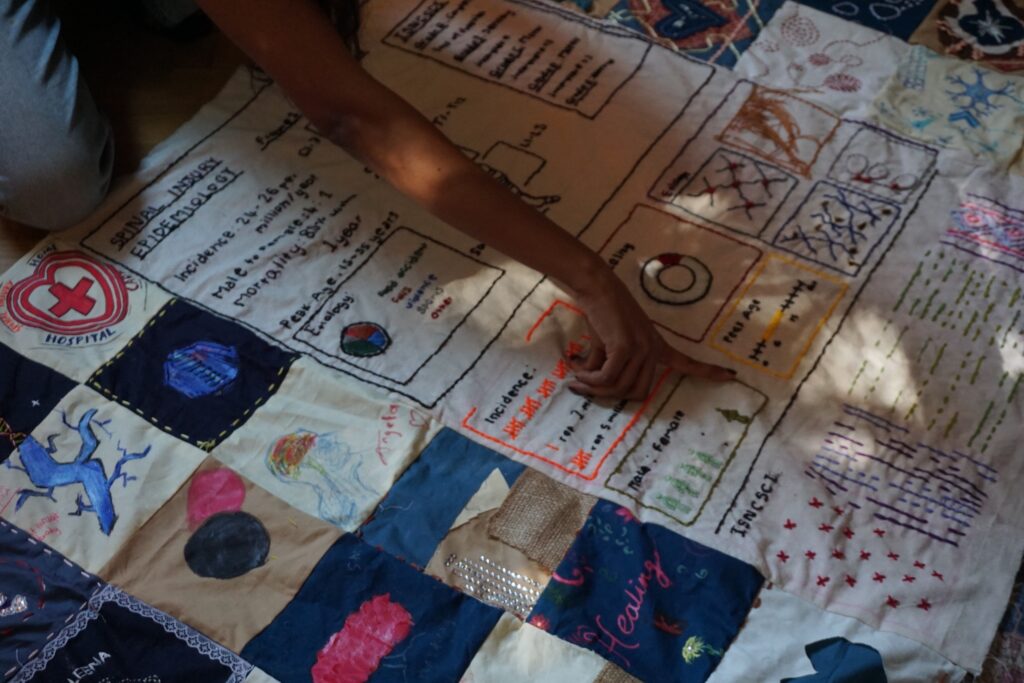
For the final section of The Spinal Hope Quilt, I wanted to bring another group into the process: researchers, clinicians, healthcare professionals, and people with lived experience of spinal injury.
The intention was to create a space where different forms of knowledge could sit alongside one another. But, there was an immediate practical problem.
Getting everyone into the same room was not realistic.
Researchers and clinicians were working around research projects, clinical responsibilities, and existing commitments. Asking them to attend another workshop meant that participation depended on having the time and flexibility to be there.
So, I changed the format.
Instead of bringing everyone together for a single workshop, I created individual textile making kits. Each contained an embroidery hoop, scissors, fabric glue, markers, fabric and lace. The kits were delivered to participants and collected afterwards, allowing them to contribute at a time and place that suited them.
This was a relatively simple change, but it made me think differently about what participation requires.
Participation is often designed around a particular format: come to a workshop, attend a discussion, join a consultation. But these formats can carry their own barriers. Time, location, professional responsibilities and confidence in unfamiliar spaces can all influence who is able to take part.
Distributed making did not remove those barriers completely. But it gave participants another way of contributing that could fit around their existing commitments.
I also wanted lived experience to be part of this section.
Serveral people with lived experience of spinal injury contributed alongside researchers, clinicians and healthcare professionals. This was deliberate.
I did not want lived experience to sit in a separate category from scientific or clinical knowledge, as though one existed to provide context for the other. Instead, I wanted different forms of knowledge to occupy the same collaborative space.
A person who has experienced spinal injury brings knowledge that cannot be gained from a research paper.
A clinician brings knowledge shaped by working with patients.
A researcher brings knowledge developed through research studies.
These forms of knowledge are different, but that does not mean that one has to be treated as the background to another.
The quilt gave me a physical way to explore this idea.
Each participant contributed a patch to the same object, using the same materials and making process regardless of their background. The patches were not identical, and they did not need to be.
That became one of the things I found most interesting about the quilt.
The patches did not need to become the same to belong to the same quilt.
I had initially thought about the quilt as an artifact that would represent different perspectives on spinal injury. But, as more patches were added, I began to see it differently. The process of making was also creating a shared space in which those perspectives could exist alongside one another.
I had hoped that this might soften some of the hierarchy between contributors.
But, I could not assume that it had.
I was still designing the project. I had decided who to invite, what materials to provide and how the contributions would become part of the final object. The participants could decide what to make, but the wider structure of participation remained mine.
This brought me back to a question from the first part of the project: what does it actually mean for something to be participatory?
Bringing different people into the same project does not automatically mean that their knowledge is being exchanged.
A researcher can contribute a patch.
A clinician can contribute a patch.
Someone with lived experience can contribute a patch.
But, what happened between those contributions?
Did people encounter knowledge that they had not considered before?
Did their perspectives change?
Did the process create dialogue between forms of knowledge that might otherwise remain separate?
One of the limitations of the project was that I did not have a systematic evaluation strategy in place to assess changes in knowledge, understanding or attitudes. I could document participation. I could see that people contributed. I could observe conversations taking place and different perspectives being represented within the final quilt.
But, participation itself is not evidence of knowledge exchange.
This distinction has made me think more carefully about how we evaluate participatory science communication.
If the purpose of a project is simply to deliver information, evaluation might focus on whether people understood or remembered that information.
But, what happens when the purpose is dialogue, contribution, or knowledge exchange?
What does success look like then?
It is tempting to treat participation as the outcome. Someone attended. Someone made something. Someone contributed an idea.
But, these things tell us that participation happened, not necessarily what happened because of it.
For me, this became one of the most important limitations of The Spinal Hope Quilt.
The project created opportunities for people to contribute, but I cannot say with confidence what those contributions changed.
That uncertainty is important.
It would be easy to describe the quilt as an inclusive space where scientific, clinical and lived experience were brought together. In some ways, that is exactly what I attempted to create.
But, inclusion cannot simply be assumed because different people are present.
Neither can knowledge exchange be assumed because people have contributed to the same object.
The quilt gave me a way to bring different forms of knowledge into the same physical space. It did not, by itself, guarantee that those forms of knowledge became equal, that dialogue occurred or that anyone’s perspective changed.
And perhaps that is the point at which unconventional science communication becomes most interesting.
Across the three sections of The Spinal Hope Quilt, changing the medium changed different parts of the communication process.
In the workshops, making changed how people could participate and communicate.
In the research paper section, changing the medium changed how scientific knowledge had to be represented and interpreted.
In the final section, distributed making created another route through which researchers, clinicians and people with lived experience could contribute.
The quilt therefore became more than a different way of presenting information about spinal cord injury.
It became a way of asking what communication might look like when the medium is allowed to shape the process itself.
I do not think quilting is inherently better than a presentation, research paper or public talk.
It has its own limitations. It cannot reproduce the methodological detail of a research paper. It cannot guarantee meaningful participation. It cannot, on its own, demonstrate that knowledge has been exchanged.
But, it can make different things possible.
It can create another way into a conversation.
It can make scientific findings visible through material and visual forms.
It can provide a shared object around which different people can contribute.
And, perhaps most importantly, it can make us question assumptions that are easy to overlook in more familiar forms of science communication.
Who gets to participate?
Who decides what participation looks like?
Who gets to interpret scientific knowledge?
And, what happens when we change not only the message, but the medium through which that message is created, represented and shared?
The Spinal Hope Quilt did not give me straightforward answers.
Instead, it made those questions part of the communication process itself.
Leave a Reply