Community Sessions Voting
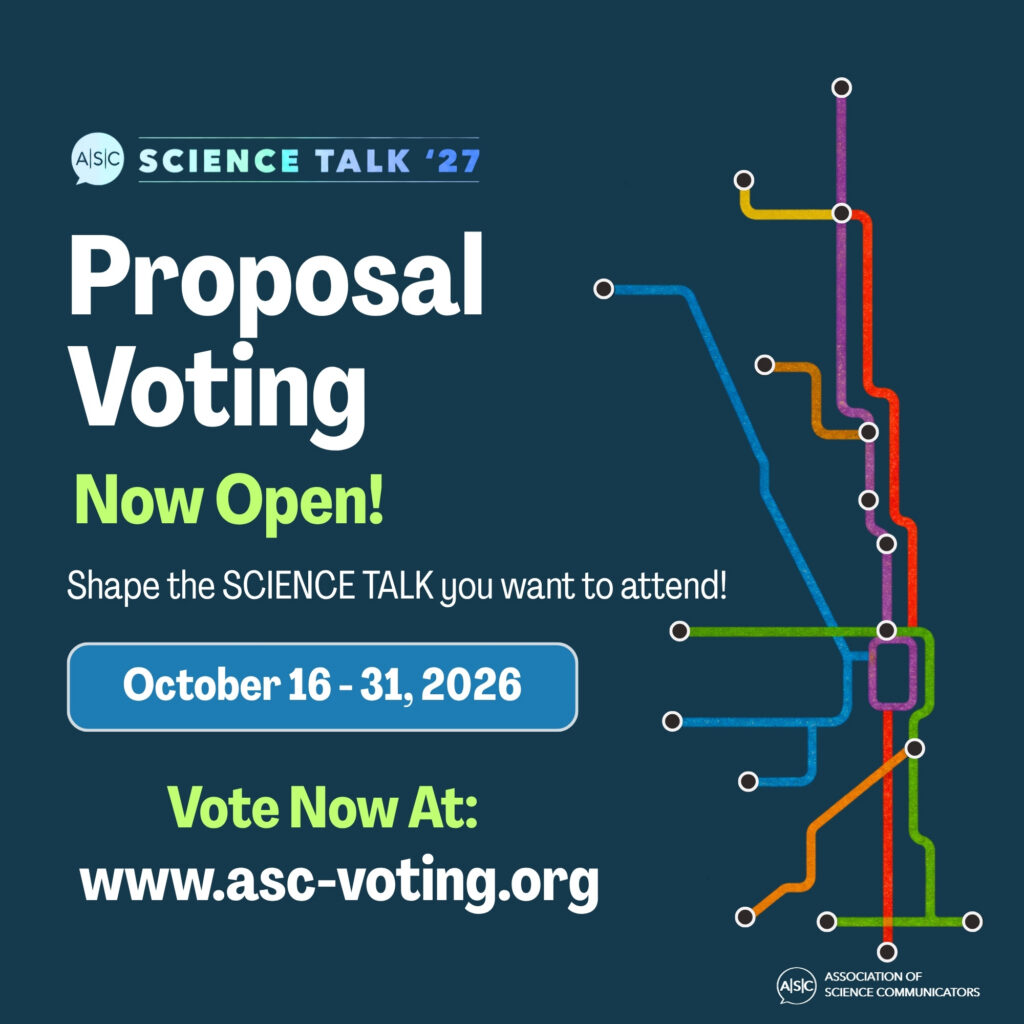
Community voting is now open for SCIENCE TALK ‘27!
October 16th–31st
Help shape SCIENCE TALK ’27 into the conference you want to attend!
Session proposal voting is open NOW. Browse the proposed panels, workshops, and short talks to vote for the sessions and speakers you most want to see at Science Talk ‘27. We want everyone in ASC & the professional science communication community to have an opportunity to vote for the speakers and sessions that they think should appear at the conference.
**The ASC conference committee curates the final program. However, community votes direct those decisions. Learn more about our community-centered model here. To volunteer for the conference committee, email info@sciencecomm.org**
** We value your input. Please vote only once per person**
Vote here: www.asc-voting.org
Voting closes: October 31, 2026 at 11:59 PM Pacific
Notification of Acceptance: All sessions will receive notice of their status no later than November 30, 2026
Early Bird Conference Registration Opens: December 1, 2026
Submissions for panel, workshop and short talk speaking opportunities are now closed. SUBMIT ART or a POSTER NOW through March 12, 2027. Conference tracks and details are posted below.
INTRODUCING SCIENCE TALK ‘27 TRACKS
This year, SCIENCE TALK ‘27 features five professional science communication tracks to ensure attendees from all walks of scicomm are represented and able to find presentations that can map to their area of practice. This year’s tracks are:
- Content Creation & Public Engagement
- Science Policy & Civic Science
- Institutional & Industry Science Communication
- The Science of Science Communication / Research
- Science Stories & More
Within each professional track, there are four types of speaking opportunities available:
- Short Talks | 20 or 40 minutes
- Focused presentations sharing research, ideas, strategies, frameworks, or practical case studies.
- Workshops | 60-90 minutes
- Interactive sessions designed to help participants build skills and leave with tools they can use.
- Panels | 45-minute moderated session
- Moderated conversations bringing together three to four perspectives around a shared question, challenge, or area of practice.
- Posters & Art | 90-minute networking poster session
- Science communication research, project case studies, infographics, creative work, STEM art, and other visual approaches to sharing your work.
FIVE TRACKS. ONE QUESTION:
How do we turn ideas, evidence, and experience into better practice?
Choose the track that best fits your work.
CONTENT CREATION & PUBLIC ENGAGEMENT
Create communication people choose to engage with.
Explore how science and technology communicators earn attention and create meaningful participation in an increasingly fragmented, visual and algorithm-driven media environment.
Topics may include storytelling, short-form video, social media, visualization, immersive and interactive experiences, audience strategy, community engagement, co-creation, accessibility, AI-assisted content creation and designing communication for how people actually consume information.
Best for: Creators, digital strategists, designers, educators, public-engagement practitioners, journalists and anyone experimenting with new ways to connect people with complex ideas.
SCIENCE POLICY & CIVIC SCIENCE
Move evidence into decisions—and bring people into the process.
Explore the intersection of science, public policy, civic participation and public trust. How can communicators help evidence travel effectively among scientists, policymakers, communities and the public without oversimplifying uncertainty or politicizing the science itself?
Topics may include communicating uncertainty and risk, evidence-informed policymaking, public participation, community engagement, misinformation, polarization, crisis communication, advocacy versus communication, science funding and communicating science in contested environments.
Best for: Policy communicators, government professionals, researchers, journalists, civic-science practitioners, nonprofit leaders and communicators working where science meets public decision-making.
INSTITUTIONAL & INDUSTRY SCIENCE COMMUNICATION
Communicate complex science and technology where the stakes are real.
Science communication doesn’t happen only in laboratories, universities and museums. It shapes business decisions, reputations, investment, innovation, regulation, workforce engagement and public acceptance of emerging technologies.
This track explores strategic communication inside and around companies, research institutions, government organizations and other complex enterprises.
Topics may include communicating AI and emerging technology, engineering and technical storytelling, executive communication, thought leadership, reputation and trust, internal communication, communicating innovation, responsible technology, crisis and risk communication, translating technical expertise for decision-makers, and demonstrating the business value of communication.
Best for: Corporate and institutional communicators, technology and engineering communicators, public affairs professionals, communication leaders, technical experts, agency professionals and anyone translating complex innovation for consequential audiences.
THE SCIENCE OF SCIENCE COMMUNICATION
Put evidence behind the practice.
What does research tell us about how people actually encounter, interpret, remember, trust and act on scientific information?
This track connects science communication research with practice—turning evidence about communication into approaches communicators can actually use.
Topics may include trust and credibility, misinformation, judgment and decision-making, cognitive science, attention and memory, framing, visual cognition, behavior change, audience research, message testing, uncertainty, evaluation and measurement, and the effects of AI-mediated information environments.
We’re particularly interested in work that closes the gap between what research discovers and what practitioners can do differently because of it.
Best for: Researchers, behavioral scientists, communication scholars, evaluators, practitioners applying evidence-based approaches, and anyone interested in understanding not simply whether communication works—but why.
SCIENCE STORIES & MORE
Make room for the unexpected.
Some of the most interesting ideas don’t fit neatly into a category.
This track is home to powerful science stories, unconventional formats, interdisciplinary work, creative experiments and emerging ideas that expand our understanding of what science communication can be.
Topics might include journalism, podcasts, film, art, performance, humor, personal narrative, speculative communication, unconventional collaborations—or something we haven’t thought of yet.
Surprise us.
Best for: Storytellers, artists, journalists, creators, experimenters and anyone pushing beyond traditional definitions of science communication.
WHAT MAKES A STRONG SCIENCE TALK PROPOSAL?
We’re looking for sessions that deliver insight + application.
Before submitting, ask:
What’s the idea?
What will attendees learn that they probably don’t know already?
Why does it matter now?
How does it connect to a challenge or opportunity facing science and technology communicators today?
What can people do with it?
What will attendees be able to apply, test, reconsider or do differently after your session?
Research is welcome. Case studies are welcome. Provocative ideas are welcome. Lessons from failure are welcome.
Sales pitches aren’t.
We built SCIENCE TALK to be a place where science communicators can compare notes, learn from one another, and make the work better together.
If you have something our community can learn from, we hope you’ll bring it to Chicago!