Science communication does not always begin with a PowerPoint.
Sometimes it begins with a needle, some thread and a question.
When I ran a series of public engagement workshops about spinal cord injury, I did not start with a presentation about the nervous system. I gave participants fabric, embroidery thread, and paint. Then, I asked:
“What comes to mind when I say spinal injury or neuroscience?”
There were no right answers. No diagrams to copy. No scientific facts to memorise.
Instead, people began to make.
The workshops, called Threads of Hope, were part of The Spinal Hope Quilt, a project that explored spinal cord injury through textiles, bringing together scientific research, lived experience and creative expression.
I had initially thought of textiles as an alternative way of communicating science: a different medium for sharing ideas that might otherwise be communicated through words, images or presentations. But as the workshops unfolded, I started to wonder whether the textile was doing more than simply carrying the communication.
What if the making was the communication?
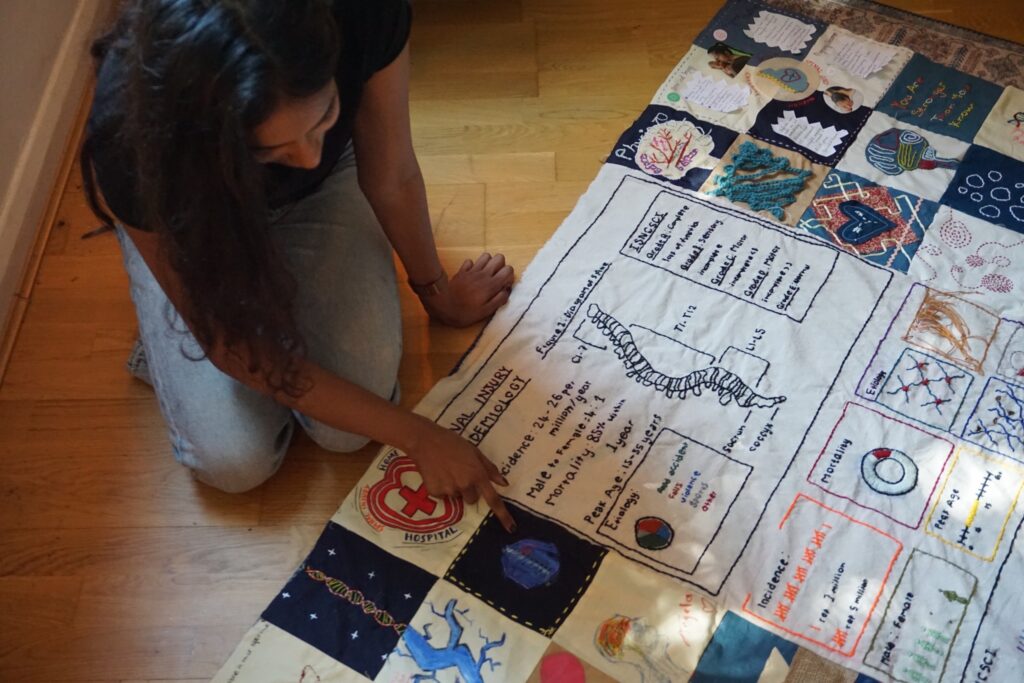
When making becomes part of the conversation
Participants responded to the question in different ways. Some sewed. Some painted. Others experimented with fabric, colour and pattern. Their responses were shaped by their experiences, emotions, questions, and curiosities. And as people made, they talked.
The stitching was not simply something to keep people occupied while the conversation happened. It became part of what made the conversation possible.
There was no requirement to move through a series of slides or reach a particular learning outcome. Instead, people could talk while choosing a colour, drawing a shape or working out how to attach one piece of fabric to another.
A conversation could start with a colour.
A memory could become a shape.
A question could become a stitch.
The making created a space where people could explore ideas without having to arrive at a single answer.
This made me reconsider what I had assumed science communication was supposed to do.
I had approached the project thinking about communication as something that happens between people: someone has knowledge, and that knowledge is communicated to someone else.
But, these workshops felt less like transferring information and more like creating the conditions for people to exchange ideas.
The textile was not just the medium through which communication happened.
It helped shape the communication itself.
But how participatory was it really?
This realisation also made me more uncomfortable with the word participatory.
Participation is often presented as a way of involving people in science: giving people a voice, creating opportunities for dialogue and allowing communities to contribute to research or its communication.
But, participation raises a deceptively simple question:
Who decides what participation looks like?
In my workshops, I chose the topic.
I designed the activity.
I wrote the question.
I selected the materials.
And ultimately, I decided how the contributions would become part of the final quilt.
I had tried to create an open space where people could respond in whatever way they wanted. But, the boundaries of that space were still mine.
That was an uncomfortable realization.
Participation had not removed the hierarchy between communicator and participant. Instead, it made me more aware of where that hierarchy remained.
It made me question whether participation is really about removing hierarchy at all.
Perhaps it is about recognizing where power sits within a communication process, and being willing to question it.
Does changing the medium change the communication?
This is where unconventional media become interesting. A quilt does not automatically make science communication more inclusive. A needle and thread do not magically create equal relationships between people. And, simply replacing a presentation with a creative activity does not mean that communication has become participatory.
But, changing the medium can change the conditions in which communication happens.
It can create different ways of speaking and listening. It can give people different ways to express ideas. It can make space for forms of contribution that might not emerge in a conventional presentation or discussion.
For me, the most important part of the workshops was not that participants had made something about spinal cord injury. It was that making gave them another way into the conversation. That distinction matters.
If we think of creative media simply as a more engaging way to deliver scientific information, we risk treating the medium as decoration. The quilt becomes an attractive container for the same message.
But, what happens when we allow the medium to influence the communication itself?
What happens when making is not something added to science communication but becomes part of how knowledge is explored, expressed and exchanged?
The Spinal Hope Quilt did not answer these questions for me.
Instead, it made the questions harder to ignore.
And, perhaps that is one of the most useful things an unconventional approach to science communication can do:
Not necessarily to communicate science better.
But, make us stop and reconsider what we think communication is in the first place.
Leave a Reply