Research papers are designed to communicate scientific knowledge within scientific communities. Their structure, terminology and conventions allow researchers to present evidence, methods and findings with precision and consistency.
But, what happens when that same research has to communicate through a completely different medium?
For the second section of The Spinal Hope Quilt, I took a published research paper on spinal cord injury and reconstructed it using fabric, thread, colour and embroidery. I kept the structure and terminology of the original paper, but reinterpreted its findings through visual and material language.
The aim was not to simplify the research. Instead, I wanted to explore what might happen when scientific findings are removed from the conventions of a research paper and given another form.
The paper itself provided the starting point. Its academic structure remained visible through the organization of the textile, while terminology, statistics and diagrams maintained a connection to conventional scientific communication.
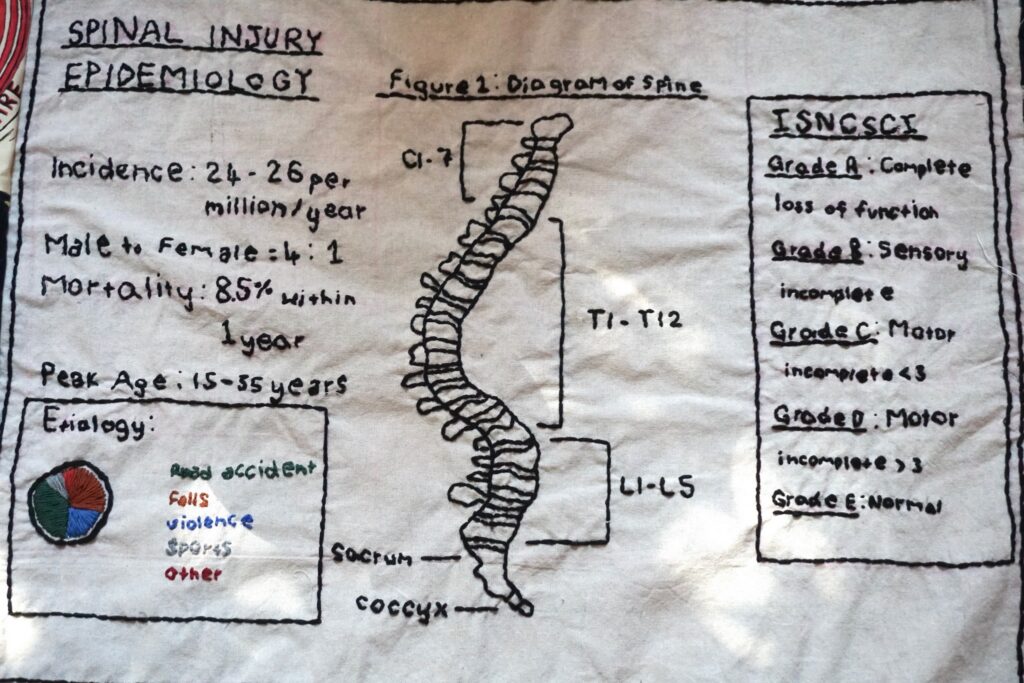
The challenge was to find ways of representing the findings without relying solely on words and numbers.
This meant thinking about what different findings could look like.
For road traffic accidents, intersecting lines represented collision and impact, with the stitching itself used to communicate disruption. For falls, descending and hanging threads represented downward movement. Violence was represented through intersecting stitches and deliberate holes, allowing the idea of disruption to be communicated without relying on graphic imagery. Sporting injuries were represented through circular embroidered patterns suggesting movement, with red introduced to signify injury.
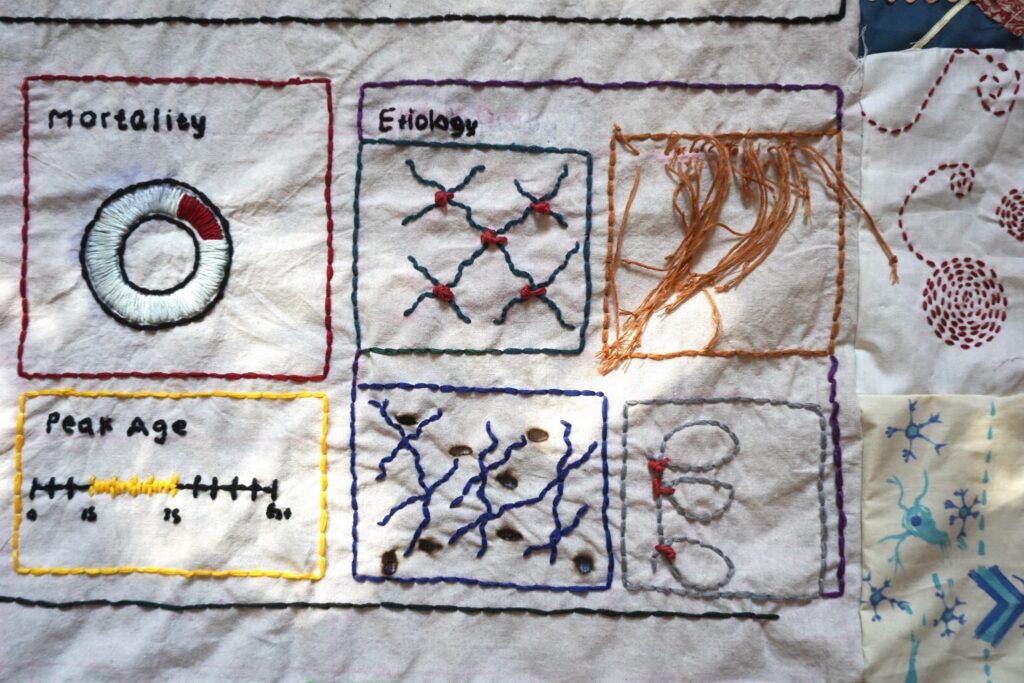
I also wanted to represent the distinction between complete and incomplete spinal cord injuries. Continuity and disruption within the patterns provided a visual way of expressing this clinical classification.
Even the stitching technique itself became part of the representation. A back stitch running along the reverse of the fabric created a material metaphor for the spinal cord.
These decisions initially seemed like a process of translating information from one format into another. However, the more I worked on the textile, the more apparent it became that this was not a neutral translation.
I had to make choices about what should remain explicit, what could be represented symbolically and what could be omitted.
A research paper can accommodate methodological detail, statistical nuance and layers of context that cannot simply be transferred into fabric. The quilt therefore could not reproduce the original paper in its entirety. Instead, it offered another way of encountering selected findings from the research.
This raised a further question: what happens when the choices involved in representing science also introduce new meanings?
Colour was one example. I used red to signify injury, but red can also evoke blood, danger, damage or tragedy. The colour therefore communicated something beyond the finding itself.
I encountered a similar consideration when representing sex within the data. Rather than using strongly contrasting colours, I chose related shades. This allowed differences to be communicated without suggesting complete separation between the groups.
These choices made me realise that scientific accuracy was only one part of the process. I also had to consider what my representations might imply.
The quilt was not a neutral reproduction of the research paper. It was an interpretation.
That does not necessarily make it less useful as a form of science communication. Instead, it highlights something that can be easy to overlook when we think about communicating science: the medium through which information is presented can influence what is emphasised, what is noticed, and how meaning is constructed.
The aim was never to create a better version of the research paper.
The paper and the quilt serve different purposes. The paper can communicate methodological detail, statistical analysis and scientific terminology in ways that the textile cannot. The quilt, meanwhile, can use colour, pattern, material and physical form to draw attention to relationships and ideas differently.
Changing the medium did not simply change how the research looked. It changed how I had to think about representing it.
And, that left me with a question that extends beyond the quilt:



Leave a Reply